
How to Build a Safety Culture That Achieves Zero Harm in Your Workplace

Building a safety culture that achieves zero harm sounds ideal, but is it achievable? Preliminary numbers in 2022 indicated 169 workplace deaths[16]. This highlights the need for stronger safety measures.
But zero harm is often criticized as an empty promise with unrealistic targets. The real question isn't just what safety culture means, but how we can develop a health and safety culture that delivers tangible results.
This piece will show you how to build a strong safety as a culture approach through leadership commitment and employee accountability. We'll walk you through practical strategies that move beyond theoretical goals. These strategies create a workplace where safety incidents become preventable realities.
Ready to transform your workplace safety? Let's delve in!
Understanding What Safety Culture Means and the Zero Harm Goal
Safety culture represents the shared values, attitudes, and behaviors that determine how seriously we protect people in our workplace. The Joint Commission defines it as the sum of what an organization is and does in the interests of safety[1]. Safety culture includes both physical safety conditions that prevent injuries and psychological safety that determines whether people will report risks they observe[17].
Key attributes include strong leadership support, acknowledgment of high-risk activities, determination to achieve safe operations, responsibility by everyone for safety implementation, a blame-free environment for reporting errors, collaboration across staff of all levels for decision-making, and organizational commitment of resources to address safety concerns[2].
Zero harm extends beyond eliminating safety incidents. Zero incidents wants to prevent recorded accidents, but zero harm focuses on proactive risk management and ensures nothing harms workers, contractors, suppliers, or the environment[3]. Employees agree on defining zero harm as "no harm to anyone, anytime while at work"[18].
Organizations implementing zero harm principles can reduce incident frequency rates by nearly three times[5]. A Canadian health system reported a 37% increase in reporting after adopting zero harm. Falls causing injuries decreased 39%, pressure injuries fell 37%, and central line-associated bloodstream infections dropped 34%[19].
Safety leaders in 2026 reframe zero harm as a continuous improvement experience rather than an absolute outcome and focus on psychological safety that encourages reporting and systemic learning[7].
Building Leadership Commitment and Employee Accountability
Management sets the tone for your entire organization when you build a health and safety culture. Accountability extends beyond disciplinary action. It has clear expectations, strong communication and effective training[4]. Employees who feel valued by their employer say they feel motivated to do their best 95% of the time. Compare this to only 32% of those who don't feel valued[8]. This gap reveals why leadership commitment must be visible and unequivocal at organizational levels of all types.
The problem starts with unclear goals. Nine out of ten companies either lack defined goals or haven't communicated them broadly. This results in 75% of employees not understanding expectations or what their organization is trying to achieve[8]. Upper management must set clear and measurable standards if employees are to fulfill expectations. If you want a monthly production report, provide exactly what should be in it. Specify the preferred format, who completes it and the due date[4].
Accountability functions at every level. Top management reviews safety programs annually and has safety in quarterly communications. Middle management tracks training completion rates and injury trends. Supervisors conduct monthly employee observations and complete incident analyzes within 24 hours. Employees follow policies and report hazards promptly. They participate in training[4]. Encouraging psychological safety where people feel safe to speak up without fear of retaliation strengthens this accountability structure[9].
Implementing Core Safety Management Processes
A safety and health culture that works requires systematic processes that translate commitment into action. Workers need detailed health and safety information covering potential risks, safe work procedures, policies and emergency responses[10]. Training follows three fundamental steps: induction for new workers, task-specific instruction and ongoing supervision[10].
Job hazard analysis identifies role-specific risks before developing generic programs[11]. A construction worker faces different hazards than office personnel, so training must reflect these realities. Annual training reviews at minimum, with additional sessions triggered when new hazards emerge, incidents occur or legislation changes[11].
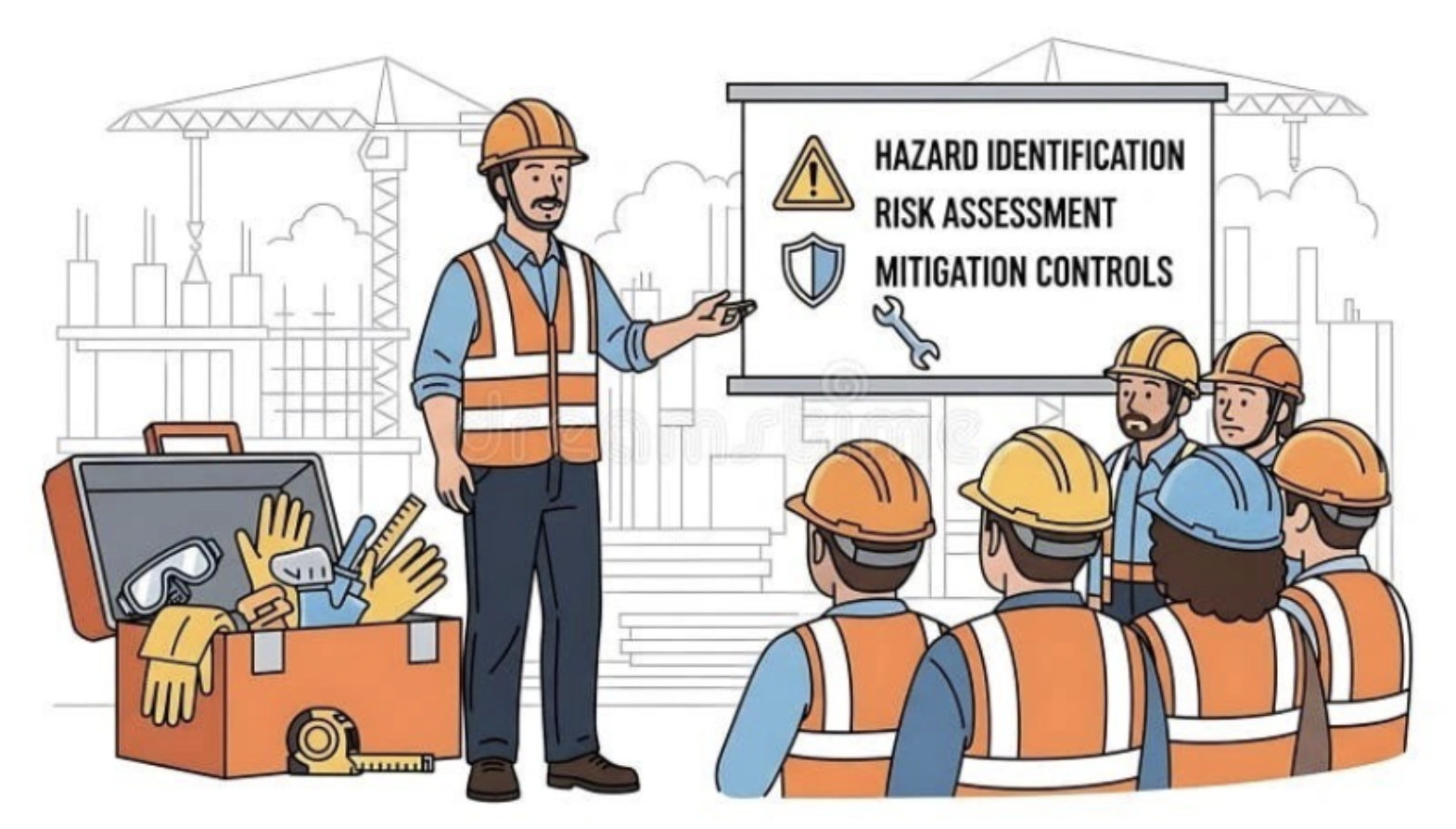
Risk management follows a structured approach: identify hazards, assess risks, control them and review effectiveness[12]. Eliminating risks provides the best control; when impossible, minimize them with the hierarchy of controls[12].
Behavior-based safety observations generate applicable information when implemented well. Research with 88 international clients and over 1.3 million observations revealed that dedicated observers prove more effective than encouraging all employees to participate[6]. Observations once monthly produce better results than more frequent ones[6]. Organizations achieved a 25% injury reduction in year one, 34% by year two and 42% by year three[6].
Audits verify whether safety management systems operate as intended[13]. Incident reporting systems capture both mandatory occurrences and voluntary submissions and create learning opportunities[14]. Evidence-based safety uses analytics from incident reports, hazard observations and wearable technology to identify patterns and predict risks[15].
Conclusion
You now have a complete roadmap to develop a genuine safety culture that moves beyond empty promises. Zero harm isn't about achieving perfection overnight. It's about consistent leadership commitment and clear accountability at every level, with systematic safety processes that work.
Start implementing these strategies today. Track your progress, encourage open reporting without fear and celebrate improvements along the way. Your workplace can become safer with each considered step forward.
References
[1] - https://www.cdc.gov/niosh/learning/safetyculturehc/module-1/4.html
[2] - https://www.cdc.gov/niosh/learning/safetyculturehc/module-1/6.html
[3] - https://www.compliancequest.com/blog/zero-harm-safety-management-processes-continuous-improvement/
[4] - https://www.saif.com/safety-and-health/accountability-at-all-levels.html
[5] - https://www.lucidity.io/news/implement-zero-harm-strategy
[6] - https://www.tandfonline.com/doi/full/10.1080/01608061.2022.2048943
[8] - https://www.powerdms.com/policy-learning-center/culture-of-accountability
[9] - https://www.apsc.gov.au/initiatives-and-programs/workforce-information/building-speak-culture-aps
[11] - https://www.sentrient.com.au/blog/effective-strategies-for-workplace-health-and-safety-training
[14] - https://iris.who.int/server/api/core/bitstreams/49947589-0a06-4708-8cc9-379bc8d2f9f2/content
[15] - https://www.myosh.com/academy/glossary/data-driven-safety
[16] - https://3cironline.edu.au/strategies-for-reducing-workplace-accidents/
[17] - https://www.leaderfactor.com/learn/what-is-safety-culture-in-the-workplace/
[18] - https://eprints.qut.edu.au/109906/2/Keith_Butler_Thesis.pdf











































.png)











.png)
.png)
.png)
.png)
.png)
.png)
.png)

.png)
.png)
.png)
.png)
.png)
.png)
.png)
.png)
.png)
.png)
.png)
.png)
.png)
.png)
.png)
.png)
.png)


Ready to Save Lives at Work?
With Impress Solutions, you’re not just getting a service, you’re securing peace of mind with a partner you can trust. Book a free consultation today, and let’s map out how we can help you save lives at work.

.png)