
Can Your Critical Controls Pass This Test?
.png)
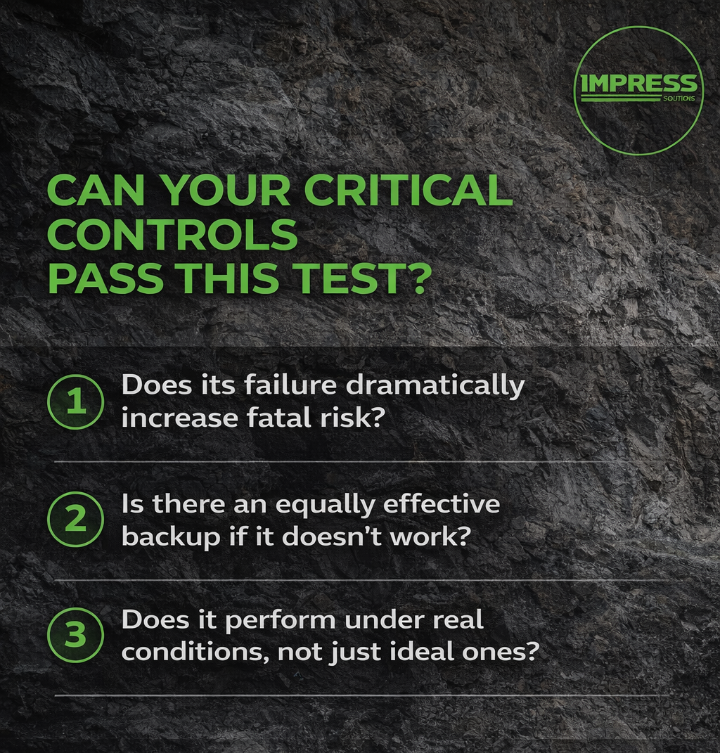
Most "critical controls" couldn't pass this simple three-question test.
Can yours?
I see it constantly across job sites.
Controls labelled "critical" that rely on perfect human behavior.
Or ideal conditions.
Or someone remembering to check.
And when they fail, nothing happens. No alarm. No escalation. No response.
Because the truth is, most organisations don't have a clear test for what makes a control truly critical.
Here's the simplest one I know:
1. Does its failure dramatically increase fatal risk?
If the answer is "maybe" or "depends," it's probably not critical.
2. Is there an equally effective backup if it doesn't work?
If yes, the system isn't truly dependent on it.
3. Does it perform under real conditions, not just ideal ones?
If it relies on perfect human behavior, attention, or memory under pressure, it's inherently fragile.
A control is only critical if all three answers align.
Because declaring something "critical" isn't categorisation.
It's a commitment.
This control must never fail.
It will be actively defended.
It has clear ownership.
And if it does fail, someone wakes up at 3am.
That's the distinction between controls that support safety and controls that prevent death.
We'll walk through how to apply this test to real examples in the February 19 session.



















































.png)
.png)
.png)
.png)
.png)
.png)
.png)

.png)
.png)
.png)
.png)
.png)
.png)
.png)
.png)
.png)
.png)
.png)
.png)
.png)
.png)
.png)
.png)
.png)


Ready to Save Lives at Work?
With Impress Solutions, you’re not just getting a service, you’re securing peace of mind with a partner you can trust. Book a free consultation today, and let’s map out how we can help you save lives at work.

.png)