7 Proven Risk Mitigation Strategies That Protect Your Business in 2026

Conduct Comprehensive Risk Assessments

Image Source: Metricstream
Risk assessment are the foundations of any risk mitigation strategy that works. You cannot protect your business adequately without understanding what threats you face.
What Risk Assessment Entails
A risk assessment is a process that identifies potential hazards and assesses the risks they present to your organization[1]. The process involves three core activities: identifying what could go wrong, analyzing the likelihood and effect of each risk, and assessing which risks require immediate attention[2].
You get into both internal and external factors that could harm your business during a risk assessment[2]. Internal risks might include outdated equipment, insufficient training or weak processes. External risks cover market fluctuations, regulatory changes, competitor actions and natural disasters. The assessment thinks about your assets (what you're protecting), threats (what could go wrong), vulnerabilities (weaknesses that could be exploited), effects (consequences if risks materialize) and likelihood (probability of occurrence)[39].
The goal is to reduce uncertainty, improve decision-making and allocate resources to address the most important risks effectively[39].
Why Regular Risk Assessments Matter
Risk assessments prepare you for changes in the business environment including evolving regulatory changes, market fluctuations, geopolitical risk and risks arising from new technology[4]. Regular assessments allow you to allocate necessary resources where needed to manage the effect of those risks efficiently at the time and where they occur[4].
OSHA recommends risk assessments at least once a year, with more frequent assessments in high-risk industries[40]. ISACA recommends security assessments at least every second year to remain compliant with HIPAA, PCI DSS and GDPR[40]. You should conduct new assessments when specific triggers occur: establishing a new business operation, introducing new equipment or procedures, changing existing work processes, or following workplace accidents and near-miss incidents[5].
You cannot identify long-term risks such as exposure to hazardous substances that could lead to fatal health problems without risk assessment that works[6]. Companies that fail to have necessary controls in place face not only financial loss through fines and civil actions but also loss in production time, damage to equipment, time to train replacement employees and negative publicity[6].
How to Conduct Risk Assessments That Work
I follow a structured approach when conducting risk assessments. The process begins with identifying potential risks by thinking about what could go wrong and why that might happen[1]. This involves walking around your workplace, checking incident reports, reviewing audit reports and discussing issues with stakeholders including staff, customers, suppliers and advisers[2].
I analyze each risk after identification by thinking about the damage it would cause and the likelihood of it happening[2]. To cite an instance, if a competitor moves onto the same street, you may receive fewer customers. You would then think about how similar the competitor's business is to yours and how loyal your customers are to determine the likelihood[2].
The assessment stage compares risks against your set criteria to decide what action to take[2]. Some risks require immediate action. Taking action for others may be more costly than allowing the risk to occur. You may choose to accept a risk if the benefits outweigh the possible damage greatly, the event has a low risk level, or the cost of avoiding the risk exceeds the cost of incurring it[2].
Documentation is integral to the process[40]. Recording identified risks, their severity, effect and proposed mitigation strategies in a centralized risk register helps maintain visibility over risks and accountability[7].
Tools and Frameworks for Risk Assessment
Several tools support risk assessments that work. A risk register serves as a centralized document recording identified risks, their severity and mitigation strategies[7]. Root cause analysis helps identify the mechanisms of a risk rather than just treating symptoms and addresses core issues to give long-term mitigation[7].
SWOT analysis assesses your business's strengths, weaknesses, opportunities and threats to inform risk management strategies[2][7]. A probability and effect matrix assesses risks based on their likelihood of occurrence and effect on operations and classifies them as low, medium or high priority[7].
Scenario analysis allows you to simulate different risk events and predict their effect, helping prepare contingency plans[7]. Key risk indicators (KRIs) are measurable values that indicate your organization's exposure to risk and provide early warnings for potential risk escalation[4][7].
Risk management software automates data collection, risk reporting and mitigation tracking[7]. These digital platforms can pull transactional and operational data from other systems via API integrations. This allows you to understand risk levels live and build a full picture of risk exposure[4].
Develop a Robust Risk Management Plan
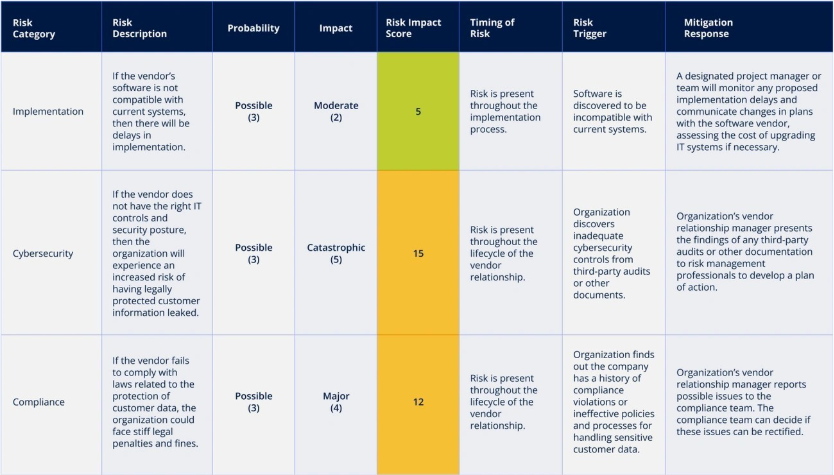
Image Source: Ncontracts
A documented strategy transforms scattered risk awareness into coordinated action. Once you've completed your risk assessment, the next step involves creating a formal risk management plan that codifies your approach.
What a Risk Management Plan Has
A risk management plan is a detailed document that captures and codifies the processes and people responsible for identifying, assessing, managing, monitoring, and reducing risks[41]. The plan defines how your risk management process will be executed. This covers the budget, tools, and approaches used to perform risk identification, assessment, reduction, and monitoring activities[42].
The document begins with an introduction or executive summary that describes the project or organizational scope, objectives, and background information[43]. This section provides an overview of your risk management approach and strategies. It sets the context for everything that follows.
After the introduction, the plan outlines your risk management methodology. It details the structured approach you'll use to identify, analyze, respond to, and monitor risks[42]. The plan establishes the specific tools, techniques, and data sources used to assess uncertainty and determine appropriate responses. It also defines roles and responsibilities, listing staff members involved in the risk process along with their specific duties[43].
Additional sections cover risk identification techniques, risk analysis and evaluation methods, response planning processes, and reduction strategies[43]. The plan describes how you'll monitor risks, the frequency of reviews, methods for identifying new risks, and schedules for reporting[43]. A risk register tracks details about each risk at the end. This covers probability, impact, overall score, and status[43].
Why Your Business Needs a Risk Management Plan
Risk management plans help you implement effective defenses by making proactive risk identification possible. You can take steps to reduce threats before they affect critical timelines or operations[41]. Without a formal plan, dealing with workplace misconduct alone cost U.S. businesses over AUD 30.58 billion in 2021[44].
The plan improves decision-making by helping you collect and utilize better risk data. This boosts your avoidance and reduction efforts[41]. Clear, well-laid-out plans improve resource allocation. They assign the right people and resources to each risk management project while reducing duplication of efforts and incomplete tasks[41].
Improved communication represents another benefit. Your plan keeps project teams, decision-makers, and stakeholders informed of progress through regular reviews and updates[41]. Identifying and managing risk through a formal plan increases the chance of successful project completion by reducing uncertainty[45].
How to Create an Effective Risk Management Plan
Creating a risk management plan starts with setting objectives. This means identifying your goals and expectations while establishing realistic targets for reducing or mitigating risk[46]. You should then identify all potential sources of risk without delay. These sources cover natural disasters, market volatility, and operational risks[46].
Analyze each risk source next by understanding the probability of occurrence and severity of impact[46]. This analysis makes it possible for you to develop risk treatment strategies, which may cover avoidance, reduction, or risk transfer[46].
Document your plan in detail. Cover all the steps outlined above plus a detailed action plan for dealing with potential risks[46]. Implementation follows documentation. Put into practice any strategies you developed for treating risks and ensure all employees understand and follow the plan[46].
Monitor risk continuously to ensure your plan remains practical and up-to-date[46]. Regular reviews should assess changes in the environment and make necessary updates. Assess your risk management plan regularly to determine its effectiveness in reducing or eliminating risks while ensuring resources are optimized[46].
Key Components to Cover
Several critical elements strengthen your plan. The risk strategy provides an overview of your approach. It specifies organizational policies you comply with and whether you're adopting a qualitative or quantitative approach[47]. Risk scope outlines specific project elements that fall within the risk management process[47].
Cover funding details that outline resources available for managing risk. This addresses staff costs, tooling, and how you'll fund treatment strategies and contingency plans[47]. The timing section specifies when and how often risk management activities will be conducted[47].
Risk categories provide structure for classifying risks. This helps in both identification and reporting[47]. Define probability and impact levels with specific criteria. Attach dollar amounts to each impact level proportionate to your project budget[47]. A risk matrix calculates risk level by cross-referencing impact and probability[47].
Document your risk tolerance to define the level and type of risk your organization is willing to accept[42]. Cover a communication plan describing the risk register's contents, format, frequency, and audience of risk summary reports[47]. The tracking section should describe how risk activities will be recorded and audited[47].
Implement Strong Cybersecurity Measures
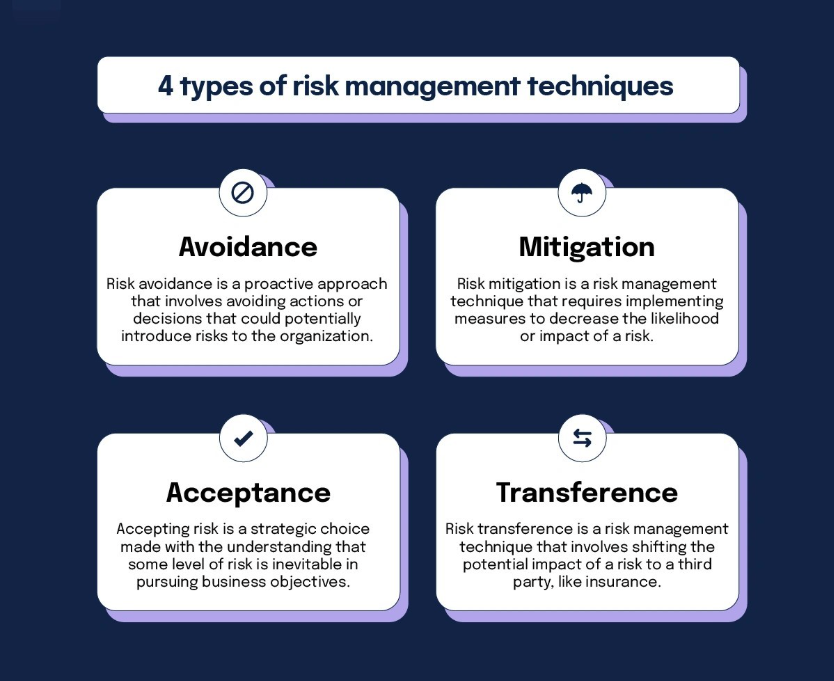
Image Source: Hyperproof
Digital threats evolve faster than most businesses can adapt. Cybersecurity measures represent your first line of defense and protect digital assets from increasingly sophisticated attacks.
What Cybersecurity Measures Involve
Cybersecurity risk management is the process by which organizations identify, review, reduce, and monitor risks to their digital infrastructure[48]. This proactive, structured approach protects information systems, networks, and sensitive data from cyber threats that stem from malicious attacks, human error, or third-party weaknesses[48].
Traditional internet security focused on perimeter defenses or post-breach response. Cybersecurity risk management differs because it's rooted in risk-based decision making[48]. The approach includes several interrelated components like risk identification, inherent risk assessment, risk scoring and prioritization, risk treatment, implementation of controls, continuous monitoring, and documentation and governance[48].
Controls may be technical (encryption, multi-factor authentication), administrative (policies, training), or physical (restricted access)[48]. The goal is to reduce the likelihood or effect of security risk materializing rather than eliminating risk entirely, which isn't possible[48].
Why Cybersecurity is Critical for Risk Reduction
Organizations fended off an average of 1,308 cyberattacks each week in early 2024, representing a 28% jump from months before[49]. Every business relies on software-as-a-service, cloud services, remote work tools, and third-party integrations. Managing risk must extend beyond internal IT systems[48].
The financial stakes are substantial. IBM's 2024 Cost of a Data Breach Report found that the average breach costs companies AUD 7.46 million globally, with much higher burdens affecting regulated sectors like healthcare and finance[48]. 70% of businesses have experienced some kind of data breach in the last three years, and 77% of those breaches originated with a third party[48].
Modern organizations rely heavily on vendors for everything from HR management to cloud infrastructure. Your systems and data can be exposed even if your internal controls are sound when one of your vendors suffers a breach[48]. This challenge is amplified by growing vendor inventories. The average company grew its vendor inventory by 21% in the last year[48].
Regulatory bodies hold organizations accountable for cybersecurity lapses increasingly, even when breaches occur via external partners[48]. Frameworks like ISO 27001, NIST CSF, and PCI DSS, as well as region-specific regulations like GDPR and the SEC's new cybersecurity disclosure rules, all require demonstrable risk management practices[48].
How to Strengthen Your Cybersecurity Posture
Strengthening your security posture begins with running a security posture assessment. This identifies gaps or vulnerabilities in your security framework that attackers could exploit[50]. The assessment reviews your cybersecurity strengths and weaknesses, current security measures, and analyzes technical defenses, user access controls, security policies, and response strategies[50].
Create a roadmap to improve your overall posture based on assessment findings. This includes updating incident response plans, enhancing employee training, implementing new security controls, and remediating vulnerabilities[50]. Cyber risk is not static. New vulnerabilities, regulatory changes, vendor incidents, internal changes, and hostile attacks can all affect your risk posture[48]. Continuous monitoring enabled by tools and intelligence becomes necessary for early detection and reduction strategies as a result[48].
Essential Security Tools and Practices
Multi-factor authentication requires a combination of something you know (PIN, secret question), something you have (card, token), or something you are (fingerprint or other biometric)[51]. Your accounts get an additional layer of security when you enable multi-factor authentication, making it harder for others to gain access[51].
Endpoint detection and response solutions detect devices that connect to your network and respond to recognized threats. They provide detailed information about device activity and gather forensic information after breaches[52]. Next-generation firewalls provide broad protections against threats while using machine learning to pinpoint malicious behavior and stop even zero-day attacks without prior knowledge of their existence[52].
Regular backups protect your business from data loss, especially when you have ransomware events[53]. Software updates include security improvements that make it harder for attackers to exploit known weaknesses in systems or applications[51]. The principle of least privilege limits access to systems and data based on user roles and responsibilities, which minimizes potential damage from compromised credentials[53].
Create a Business Continuity Plan
Image Source: Akamai
Operational disruptions can halt your business within hours. A business continuity plan provides the structured framework you need to maintain operations when unexpected events threaten your ability to function.
What Business Continuity Planning Entails
A business continuity plan is a document that outlines the steps your business needs to take before, during, and after an unexpected event or emergency[54]. Business continuity planning frameworks guide businesses to maintain operations, safeguard stakeholders' interests, and survive potential crises[12].
The framework incorporates interrelated processes, methodologies and standards to boost an organization's resilience and responsiveness to disruptions[13]. Business continuity planning identifies potential threats at its core, assesses their effect on critical business functions, and creates strategies to minimize disruption and make swift recovery easier[13]. Threats may include natural disasters, power outages, public health emergencies, civil unrest, cyberattacks, supply chain issues, reputational damage or acts of terror[55].
Business continuity planning is different from disaster recovery planning in scope. Disaster recovery focuses on technology and IT infrastructure. Business continuity plans cover the entire organization, including customer service and supply chain operations[56].
Why Business Continuity Plans Protect Your Business
Business continuity planning protects staff and assets. The plans keep employee safety intact and safeguard critical resources[54]. They minimize downtime by keeping essential services running and limiting operational disruptions[54]. Organizations that demonstrate a proactive approach to risk management and business continuity build trust among stakeholders, including customers, partners and investors[13].
Every minute that your business is offline proves expensive[57]. Threats, disruptions or halts to business activity for any period mean losses and higher costs. Starting back again becomes difficult, leading to a drop in profitability, financial loss and the potential for bankruptcy and liquidation[56]. Businesses cannot rely on insurance alone because it doesn't cover all costs or customers who move to the competition[56].
Adhering to a business continuity management framework will give compliance with legal and regulatory requirements and alleviates potential legal repercussions during disruptions[13]. Certain industries mandate formalized business continuity plans under regulatory norms, which further underscores their importance[12].
How to Develop a Business Continuity Plan
Creating a business continuity plan begins with a detailed assessment of business continuity risks. This includes financial and operational risks and threat scenarios which may disrupt your operations[8]. Conduct a business impact analysis next to assess the effect of identified risks[8]. The business impact analysis determines the criticality of business functions and potential losses. This enables you to determine recovery strategies, priorities and recovery time objectives[8].
Develop recovery strategies and procedures based on your findings to sustain or restore operations quickly[17]. These strategies may involve redundancy in IT infrastructure, alternate processing sites, multi-vendor sourcing, workforce cross-training or remote work capabilities[17]. Document step-by-step procedures to restore critical functions within stipulated time frames[12].
Training employees proves important. Their familiarity with procedures helps keep execution smooth when faced with unexpected events[12]. Workplace simulations of possible risks help identify how prepared you and your staff are. They reveal how quickly staff can locate the plan and enact incident checklists, and identify gaps and problems with the plan[54].
Critical Elements of an Effective Plan
An effective business continuity plan documents several critical elements. Include continuity arrangements for critical functional capabilities if your primary office becomes inaccessible. This includes availability of a disaster recovery site ready for activation within a reasonable period[8]. Establish a communications plan to liaise with internal and external stakeholders such as employees, customers and regulatory authorities during a crisis[8].
Identify key personnel and management staff, their roles and responsibilities, and reporting lines. Include alternates to cover responsibilities of absent key personnel[8]. Define critical business functions whose failure or disruption may incapacitate the firm[8]. Assess dependencies on key service providers in recovery strategies and recovery time objectives[8].
Regular testing and updates keep your plan practical and up-to-date[12]. Version control, periodic reviews and storage in multiple available formats keep plans current[17].
Transfer Risk Through Insurance and Partnerships
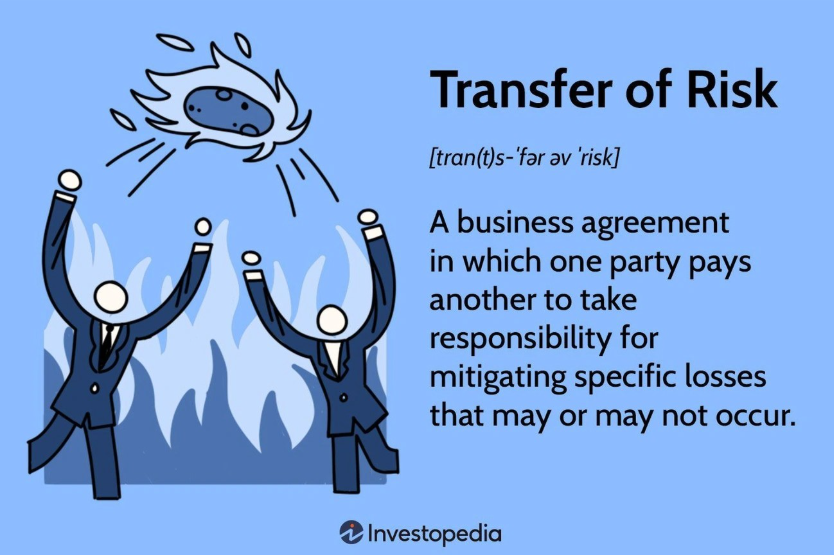
Image Source: Investopedia
Not every risk requires direct management within your organization. Risk transference changes the financial or operational consequences of specific threats to external parties better equipped to handle them.
What Risk Transference Means
Risk transference is a risk management strategy that involves changing responsibility for potential losses from one party to another through contractual agreements or insurance policies[18]. You move the burden of managing certain consequences to third parties while the threat itself remains[9]. Organizations transfer risk to entities with greater expertise or resources to handle specific exposures[19]. A manufacturing company might purchase cyber insurance to transfer the financial effect of a data breach. A software firm could outsource server maintenance to change operational risks to a specialized provider[19].
Why Risk Transfer is a Smart Mitigation Strategy
Insurance helps protect your customers, earnings, employees and business assets such as equipment, premises and stock[20]. Transferring risk provides financial protection against catastrophic losses that would otherwise require substantial reserves[11]. You gain access to coverage that shields your organization from unexpected events by paying predictable premiums[11]. This approach allows you to focus on core activities while ensuring specific risks are managed by parties better positioned to control them[18]. Risk transfer also provides peace of mind and reduces the mental burden of managing uncontrollable risks constantly. Your team can focus on productive activities[21].
How to Transfer Risk Effectively
Smart businesses require other parties to carry insurance or sign agreements that indemnify or hold them harmless as a condition of doing business[22]. Require Certificates of Insurance directly from the insurance company or broker before third parties begin work or before submitting payment[22]. Review these certificates annually or semi-annually to verify sufficient coverage terms and maintain them in your files[22]. Involve legal advisors with contract drafts before execution to ensure proper risk allocation[22]. Monitor relationships and performance of third parties to alleviate new risks like non-compliance or financial instability that may arise from the transference strategy continuously[23].
Types of Insurance and Contractual Risk Transfer
Workers compensation insurance is the only business insurance Australia requires legally if you have employees[24]. Public liability insurance covers you if someone dies, gets injured or has their property damaged because of your negligence[20]. Professional indemnity insurance helps cover legal action costs from claims against your professional advice or services[20]. Product liability insurance may be needed if you make, sell or supply goods[20]. Technology and cybercrime insurance protects your business from cybercrime costs[20].
Contractual risk transfer uses legally binding agreements to change risk to parties best positioned to control it[10]. Common components include hold harmless agreements or indemnification clauses that outline contractor responsibilities and the duty to defend when their work results in injury or damages[10]. Additional insured status on another party's policy may entitle you to certain rights under their coverage[22]. A waiver of subrogation prevents the contractor's insurer from seeking recovery from you even if you were partially responsible for a loss[10].
Train Employees on Risk Management

Image Source: SafetyDocs by SafetyCulture
Your workforce represents the human layer of every risk mitigation strategy you implement. Even the most sophisticated plans and technologies fall short of their potential without proper training.
What Employee Risk Training Involves
Risk management training refers to the process of teaching individuals or teams how to manage corporate risks[25]. The training wants to impart the skills, knowledge and tools needed to recognize and assess hazards that could affect the organization[25]. Training objectives include raising awareness about different types of risks and developing a culture of alertness in spotting risks. They also train employees in strategies for assessing and mitigating identified risks, establish processes for ongoing monitoring and reporting, and prepare individuals to respond during crisis events[25].
Why Employee Training Strengthens Risk Mitigation
Organizations with reliable risk management frameworks and trained staff experience a 30% reduction in workplace incidents and a 20% decrease in financial losses[26]. Training helps establish a risk-based approach to thinking and equips employees to raise red flags to managers[15]. Employees see your company investing in training, and it demonstrates you're watching out for their safety, customers and the business[15].
International risk management standard AS/NZS ISO31000 defines a control as a measure that modifies risk. Staff training is often identified as a control for risks in an organization's risk register[27]. After major fraud or corruption investigations, agencies often make recommendations for further staff training[27].
How to Implement Training Programs That Work
Risk management training covers several delivery methods depending on specific needs[25]:
- Lecture-Based Training: Traditional classroom or virtual sessions covering risk fundamentals
- Workshops and Seminars: Interactive sessions that encourage participation and practical exercises
- Digital Training Platforms: Online courses that provide flexibility and on-demand access
Training should begin with onboarding, where every recruit gains a full understanding of regulatory compliance policies[28]. Therefore, place new employees into mentorship programs with experienced managers to further their skills[28]. Training proves most effective when ongoing and interactive rather than one-off sessions[29].
Key Training Areas and Best Practices
A detailed program should cover risk management fundamentals including key concepts, principles and terminology, plus different types of risks and frameworks such as ISO 31000[25]. Include risk identification techniques and assessment methods covering qualitative and quantitative analysis. Mitigation strategies such as risk avoidance, reduction and transference should also be covered[25]. Training should establish processes for ongoing monitoring, including early warning systems and key risk indicators, and demonstrate how to create risk reports for stakeholders[25].
Customize content for different roles to improve engagement and relevance[29]. Use real scenarios from your organization and industry-specific incidents rather than generic training slides[29]. Leadership support boosts training uptake, so give leaders the tools to discuss risks openly, lead by example and encourage reporting of near misses[29]. Regular refresher training helps workers remain informed about workplace health and safety, including any changes in work practices or procedures[30].
Monitor and Review Risk Mitigation Strategies Regularly
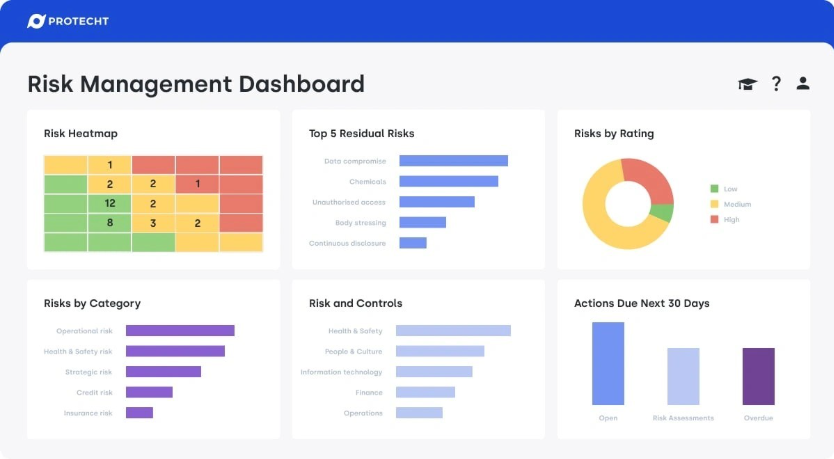
Image Source: Protecht
Static risk management plans become obsolete the moment conditions change. Ongoing watchfulness separates resilient organizations from those caught unprepared.
What Continuous Risk Monitoring Entails
NIST SP 800-137 defines continuous monitoring as ongoing awareness of information security, vulnerabilities and threats to aid risk-based decision making[31]. This live process identifies, assesses and alleviates risks before they damage operations, profitability or reputation[32]. Key components include live data access that provides an up-to-date view of the risk environment and automation to streamline monitoring activities[33].
Why Regular Reviews are Essential
Regular reviews demonstrate your commitment to safety and risk management to regulators and stakeholders[3]. Risk monitoring boosts efficiency by making information available right away, so you can detect disruptions before they cascade into operational bottlenecks[33]. Controls can fail silently. A policy may be documented yet ignored[14]. Continuous monitoring identifies whether controls function genuinely, not just when they were last checked on paper[14].
How to Monitor and Update Your Risk Mitigation Strategy
Begin by determining which risks require continuous monitoring and distinguish high-priority from low-priority threats[32]. Plan by identifying key risk indicators and deciding where monitoring provides the greatest value[33]. Select technology that arranges with your framework and integrates with existing systems[33]. Encourage a risk-aware culture through training and communication to ensure staff understand their role in identifying and reporting risks[33].
Metrics and Tools for Ongoing Assessment
Establish clear metrics including frequency of risk assessments and response time to identified risks[33]. Key risk indicators are forward-looking metrics tied to risk exposure that signal potential events before they occur[16]. Track risks identified per quarter, risks alleviated within target timeframes and risk realization rate[34]. Continuous control monitoring evaluates control effectiveness using live data and provides near-live visibility into control performance[35].
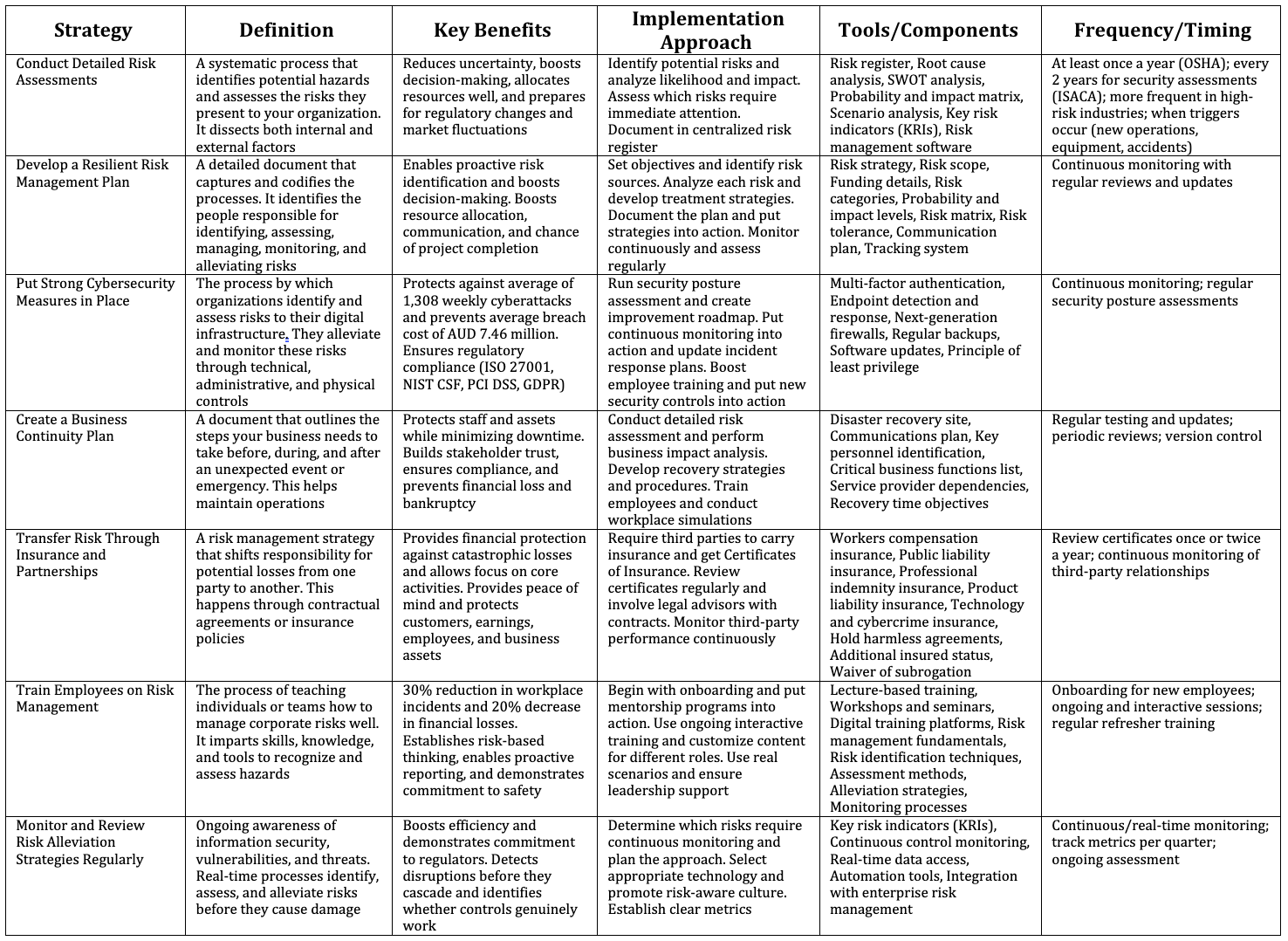
Comparison Table
Comparison Table: 7 Proven Risk Alleviation Strategies
Conclusion
These seven risk mitigation strategies may seem overwhelming at first, but you don't need to tackle everything at once. Start with a full risk assessment that identifies your critical vulnerabilities. Prioritize strategies based on your specific business needs and available resources after that.
You'll position your organization to withstand disruptions that would otherwise cause major damage when you build strong defenses through complete planning, solid cybersecurity, business continuity preparation, risk transfer, employee training and continuous monitoring.
Risk management is a continuous commitment rather than a one-time project. Review and adapt your strategies to stay protected in 2026 and beyond.
References
[2] - https://business.sa.gov.au/information/running-my-business/risk-assessment
[5] - https://www.hiscox.co.uk/business-blog/what-is-a-risk-assesment
[7] - https://www.chas.co.uk/blog/essential-risk-management-tools/
[8] - https://rulebook.sgx.com/rulebook/21-critical-elements-business-continuity-plan
[9] - https://safetyculture.com/topics/risk-management/risk-management-strategies
[11] - https://grm.institute/blog/risk-transference-explained-types-examples-business-benefits/
[12] - https://bryghtpath.com/business-continuity-planning-frameworks/
[14] - https://www.sentrient.com.au/blog/continuous-risk-monitoring
[15] - https://hsi.com/blog/4-reasons-to-have-training-for-risk-management
[16] - https://www.bakertilly.com/insights/importance-risk-metrics-kri-kpi-erm-framework
[17] - https://faddom.com/business-continuity-framework-6-components-and-4-popular-frameworks/
[18] - https://www.metricstream.com/learn/risk-transference.html
[19] - https://www.splunk.com/en_us/blog/learn/risk-mitigation.html
[20] - https://business.gov.au/risk-management/insurance/types-of-business-insurance
[21] - https://safetyculture.com/topics/risk-management/risk-transference
[23] - https://hyperproof.io/resource/risk-management-techniques/
[24] - https://www.xero.com/au/guides/types-of-business-insurance/
[25] - https://safetyculture.com/topics/risk-management/risk-management-training
[26] - https://www.tcptraining.com/online-courses/risk-management-course-online
[28] - https://deakinco.com/resource/how-to-improve-risk-management-skills-in-your-company/
[29] - https://nationaltraining.edu.au/train-staff-on-risk-awareness/
[31] - https://csrc.nist.gov/CSRC/media//Projects/Forum/documents/2012/dec2012_cont_montor_risk_mgmt.pdf
[32] - https://legal.thomsonreuters.com/blog/continuous-monitoring-an-overview/
[34] - https://www.diligent.com/resources/blog/measuring-erm-performance
[35] - https://www.cybersaint.io/blog/the-top-5-automated-risk-assessment-tools
[37] - https://mha-it.com/blog/four-types-of-risk-mitigation?hs_amp=true
[38] - https://www.ibm.com/think/insights/risk-mitigation-strategy
[39] - https://www.centraleyes.com/risk-assessment-methodologies/
[40] - https://www.velappity.com/risk-assessment-best-practices/
[41] - https://www.atlassian.com/work-management/project-management/risk-management-plan
[42] - https://www.projectmanager.com/blog/risk-management-plan
[44] - https://online.hbs.edu/blog/post/risk-management
[46] - https://www.allianz-trade.com/en_US/insights/risk-management-plan.html
[47] - https://www.projectbalm.com/blog/elements-of-a-risk-management-plan/
[48] - https://www.whistic.com/the-importance-of-robust-cybersecurity-risk-management
[49] - https://onlinedegrees.etsu.edu/articles/importance-of-cybersecurity-risk-management/
[50] - https://www.sentinelone.com/cybersecurity-101/cybersecurity/cybersecurity-posture/
[52] - https://www.fortinet.com/resources/cyberglossary/smb-cybersecurity-tools
[53] - https://cymulate.com/blog/strategies-for-effective-cybersecurity-risk-mitigation/
[54] - https://www.business.qld.gov.au/running-business/risk/continuity-plan
[55] - https://www.jpmorgan.com/insights/business-planning/what-is-a-business-continuity-plan
[56] - https://www.investopedia.com/terms/b/business-continuity-planning.asp
[57] -https://www.arcserve.com/blog/6-steps-developing-business-continuity-plan










































.png)











.png)
.png)
.png)
.png)
.png)
.png)
.png)

.png)
.png)
.png)
.png)
.png)
.png)
.png)
.png)
.png)
.png)
.png)
.png)
.png)
.png)
.png)
.png)
.png)
.png)
.png)
.png)
.png)
.png)


Ready to Save Lives at Work?
With Impress Solutions, you’re not just getting a service, you’re securing peace of mind with a partner you can trust. Book a free consultation today, and let’s map out how we can help you save lives at work.

.png)